Why Jewelry Components Matter
A successful jewelry design depends on more than its appearance. Every finished piece is made up of individual jewelry components that work together to deliver comfort, durability, functionality, and visual appeal.
From an earring post to a necklace clasp, even the smallest part can influence the quality of the final product. A poorly sized jump ring may open under stress. An unsuitable earring post may cause skin discomfort. A weak plating system may lose its color faster on a ring shank or bracelet clasp.
For jewelry brands, wholesalers, designers, and retailers, understanding the parts of jewelry is an important step toward making better sourcing decisions.
According to Grand View Research, the global jewelry market was valued at approximately USD 381.5 billion in 2025 and is estimated to reach USD 397.7 billion in 2026. Rings accounted for approximately 33.9% of global jewelry market revenue in 2025. These figures illustrate the scale of the industry, although market size alone does not determine the quality requirements of individual products.
For businesses developing new collections, the next step is understanding how each component affects jewelry manufacturing performance and the customer experience.
At MCGA Jewelry, a Vietnam-based jewelry manufacturer, we support B2B jewelry projects involving material selection, product development, sampling, surface finishing, jewelry quality control, and customized production.
This guide explains the essential parts of jewelry, their functions, the materials commonly used, and the key questions buyers should ask before approving a production sample.
1. What Are the Main Parts of Jewelry?
The parts of jewelry can be divided into three main groups:
Structural components: Parts that form the main body of a product, such as ring shanks, chain links, bracelet links, and pendant bodies.
Connecting components: Parts that connect different elements, including jump rings, bails, connectors, and end caps.
Functional components: Parts that make jewelry wearable and secure, such as jewelry clasps, earring backs, hinges, and locking mechanisms.
Many designs combine all three groups. A pendant necklace, for example, may contain a decorative pendant, a bail, a chain, several jump rings, and a clasp.
Each component has its own dimensions, material requirements, and manufacturing tolerances. Buyers should therefore review the complete assembly instead of evaluating only the visible design.
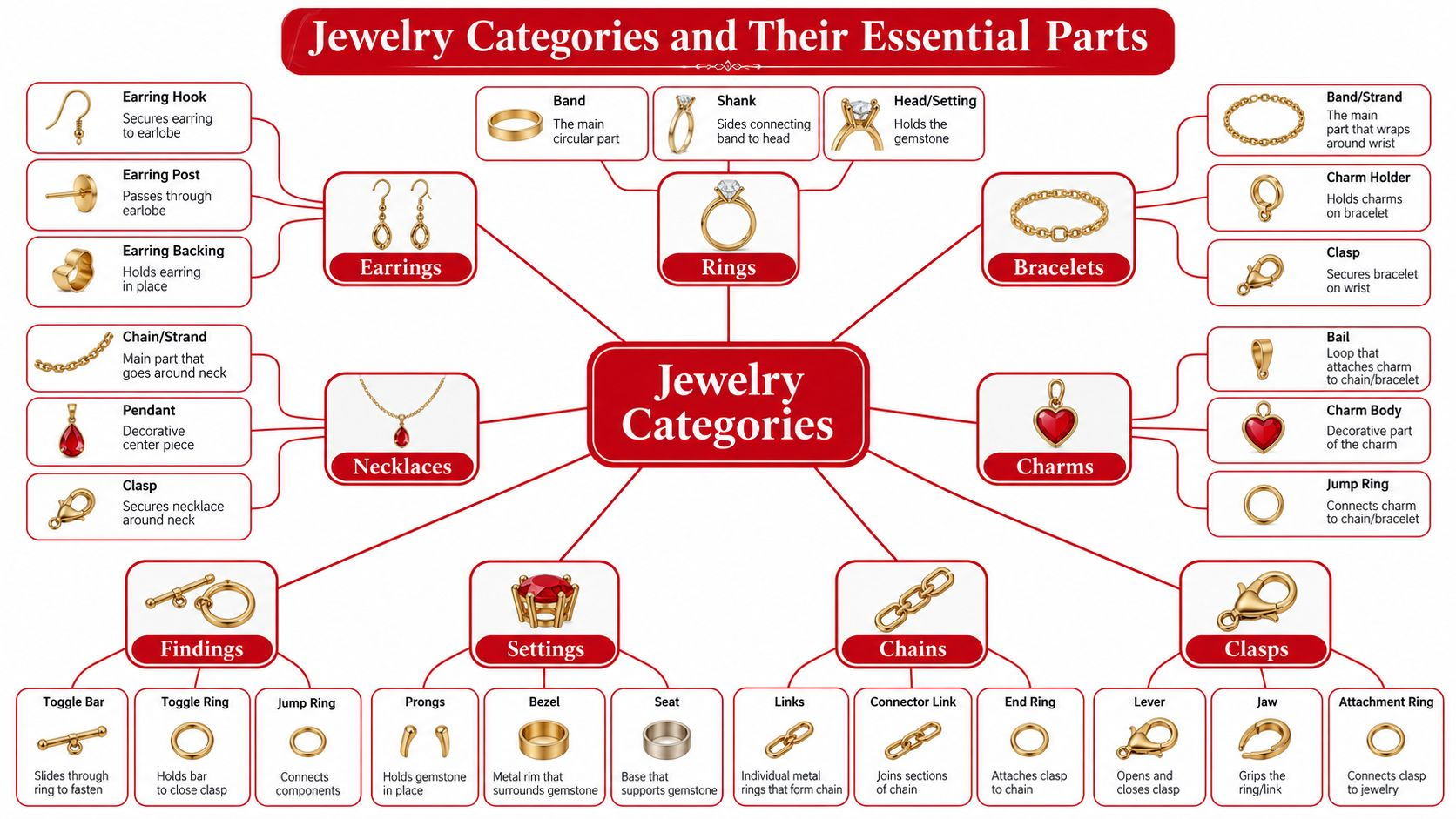
Common Jewelry Components at a Glance
| Component | Main Function | Common Applications |
|---|---|---|
| Shank | Forms the main band of a ring | Rings |
| Chain links | Create flexible connections | Necklaces, bracelets |
| Jump ring | Connects separate jewelry parts | Pendants, chains, clasps |
| Bail | Attaches a pendant to a chain | Pendant necklaces |
| Clasp | Opens and closes a jewelry piece | Necklaces, bracelets |
| Earring post | Passes through the ear piercing | Stud earrings |
| Earring back | Secures the earring post | Stud earrings |
| Setting | Holds a gemstone or decorative element | Rings, earrings, pendants |
| End cap | Finishes or secures a chain end | Necklaces, bracelets |
| Hinge | Allows a component to open and close | Hoop earrings, hinged bangles |
Understanding these jewelry parts names makes it easier to communicate with a jewelry manufacturer, prepare a technical specification, and identify potential production issues before mass manufacturing.
2. Earring Components Explained
Earrings often contain small jewelry components that require precise dimensions and careful assembly. The most important parts depend on the earring style.
Earring Posts and Backs
An earring post is the straight metal stem that passes through a pierced ear. An earring back holds the post in position.
Common backing types include:
Butterfly backs: Widely used for stud earrings because they are compact and easy to assemble.
Clutch backs: Available in different shapes and sizes for different post designs.
Screw backs: Use a threaded mechanism for a more secure fastening system.
Silicone backs: Offer a lightweight alternative for selected earring designs.
For OEM jewelry manufacturing, the post material should be specified separately when it differs from the decorative earring body.
Buyers should check post straightness, surface smoothness, backing fit, and the force needed to attach or remove the backing. These details influence comfort and usability.
Earring Hooks and Lever-Backs
Hook earrings use a curved wire that passes through the ear. They are common in lightweight drop and dangle designs.
Lever-back earrings feature a hinged closure that helps retain the earring during wear. They can be suitable for designs that require a balance between movement and closure security.
When developing custom jewelry, manufacturers should also consider the weight of the decorative element. A heavy pendant attached to a fine hook may affect balance and comfort.
Earring Quality Checklist
Before approving a sample, review:
Post diameter and length.
Smoothness of skin-contact surfaces.
Backing tension and retention.
Alignment between the post and decorative body.
Joint strength on multi-part earrings.
Finish consistency around hinges and connection points.
MCGA sourcing tip: If the earring body and post use different materials, record both materials in the product specification. A general description such as “gold-tone earrings” is not sufficient for production control.
3. Key Parts of Rings and Bracelets
Rings and bracelets experience repeated friction, movement, and contact with the skin. Their structural components need to balance appearance with mechanical performance.
Main Parts of a Ring
A ring typically includes the following components:
Shank: The main band that surrounds the finger.
Shoulders: The sections that connect the band to the upper design.
Head: The upper part of the ring that holds or supports the decorative element.
Setting: The structure used to secure a gemstone or other decorative element.
Inner band: The surface that contacts the finger.
The shank requires particular attention because it experiences frequent friction during daily use. A design that is too thin for its intended material and geometry may deform more easily.
The head and setting must also be properly aligned. An excessively high setting can increase the risk of snagging or impact, depending on the product's intended use.
For plated rings, the underside of the shank and other high-contact areas deserve additional inspection because repeated abrasion can reveal finish wear.
Main Parts of a Bracelet
Bracelets may include:
Links or a solid cuff body.
Hinges and hinge pins.
End caps and connecting rings.
Jewelry clasps or locking mechanisms.
Safety chains or secondary closures, where applicable.
Chain bracelets often experience concentrated stress near the clasp and end connections. Rigid bangles may require tighter dimensional control around hinges and locking parts.
For a reliable design, the clasp, connecting rings, and bracelet body should be evaluated as one assembly. A strong center section cannot compensate for an undersized connection.
What Buyers Should Specify
When preparing a technical pack, include:
Ring shank width and thickness.
Inner-band finishing requirements.
Bracelet opening dimensions and fit.
Hinge and clasp construction.
Material and surface-finish specifications.
Stone-setting details, where applicable.
Inspection requirements for stress-bearing connections.
These details help jewelry manufacturers assess feasibility and identify potential issues before production begins.
4. Necklace and Chain Components
Necklaces combine decorative elements with flexible connections. The chain must support the pendant, create the intended drape, and remain compatible with the closure system.
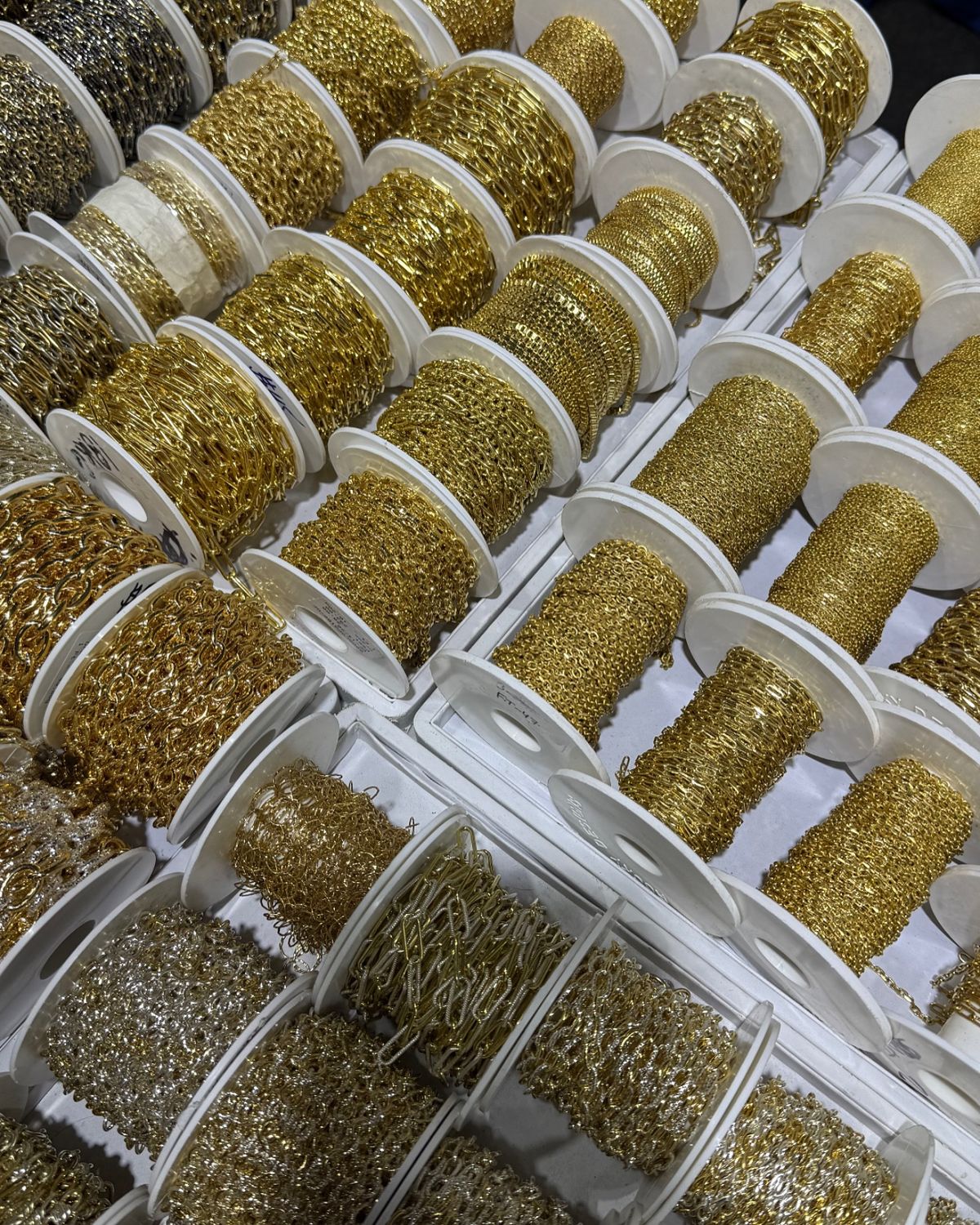
Common Types of Jewelry Chains
Cable chain
Made from individual interconnected links. It is versatile and commonly used for pendants and charm necklaces.
Curb chain
Features links designed to sit relatively flat. It can create a stronger visual presence for statement necklaces and bracelets.
Box chain
Uses square-shaped links to create a structured, geometric appearance.
Snake chain
Features closely connected elements that create a smooth surface. It requires appropriate handling because kinking may affect its appearance and usability.
Rolo chain
Uses rounded links to create a balanced, dimensional appearance for necklaces and bracelets.
The best chain depends on the pendant weight, design style, intended wearer, and target price.
Essential Necklace Components
Pendant: The main decorative element of a pendant necklace.
Bail: Connects the pendant to the chain. Its opening must accommodate the chain dimensions.
Jump ring: Connects the pendant, chain, or clasp components.
Extender chain: Provides adjustable necklace or bracelet length.
End cap or end tab: Finishes and secures the chain end.
Clasp: Allows the wearer to open and close the necklace.
How to Match a Chain to a Pendant
A chain and pendant should be evaluated together rather than specified independently.
Consider the following factors:
Pendant weight and attachment-point strength.
Chain width and link construction.
Bail opening and chain thickness.
Clasp size relative to the chain.
Desired movement and drape.
Resistance to tangling for layered designs.
For custom jewelry manufacturing, confirming these details during sampling can reduce assembly changes and help prevent avoidable failures in bulk production.
5. Jewelry Findings and Clasp Mechanisms
Jewelry findings are the small functional components that connect, secure, or finish a jewelry piece. They are often less visible than the main design, but they have a direct impact on product usability.
Common Types of Jewelry Findings
| Finding | Function | Key Quality Check |
|---|---|---|
| Jump ring | Connects jewelry components | Closure and wire thickness |
| Split ring | Provides a more resistant attachment loop in suitable designs | Ring integrity and opening |
| Head pin | Holds beads or decorative elements | Length and end formation |
| Eye pin | Creates a loop for connecting components | Loop consistency |
| Connector | Joins different sections of a design | Alignment and joint strength |
| Crimp component | Secures selected wire or cord constructions | Grip and deformation |
| Bail | Attaches a pendant to a chain | Opening size and strength |
| End cap | Finishes chain or cord ends | Fit and retention |
The appropriate finding depends on the design, material, dimensions, and intended use.
For example, a jump ring used to attach a lightweight charm may require different specifications from one supporting a heavier pendant.
Choosing the Right Jewelry Clasp
Lobster clasp
A spring-loaded closure commonly used on necklaces and bracelets. It offers a practical balance between security and usability.
Spring ring clasp
A compact circular closure often used on lightweight chains. Its small size can make it more difficult for some customers to operate.
Toggle clasp
Uses a bar and a receiving loop. It can become part of the visual design, but its dimensions and balance must be suitable for the jewelry piece.
Magnetic clasp
Uses magnetic attraction to connect two ends. Its retention must be evaluated for the product's weight and intended movement.
Box clasp
Uses a shaped insert and receiving mechanism. Some designs incorporate an additional safety feature.
Three Questions to Ask Before Approval
Can the clasp remain securely closed during normal movement?
Can the intended customer open and close it comfortably?
Are the clasp, jump rings, and end connections appropriately sized for the product?
A clasp should never be selected on appearance alone. Its mechanical performance is part of the complete product specification.
6. Jewelry Settings and Mounting Styles
A jewelry setting holds a gemstone or decorative element in place. Its structure affects appearance, stone protection, cleaning, finishing, and manufacturing complexity.
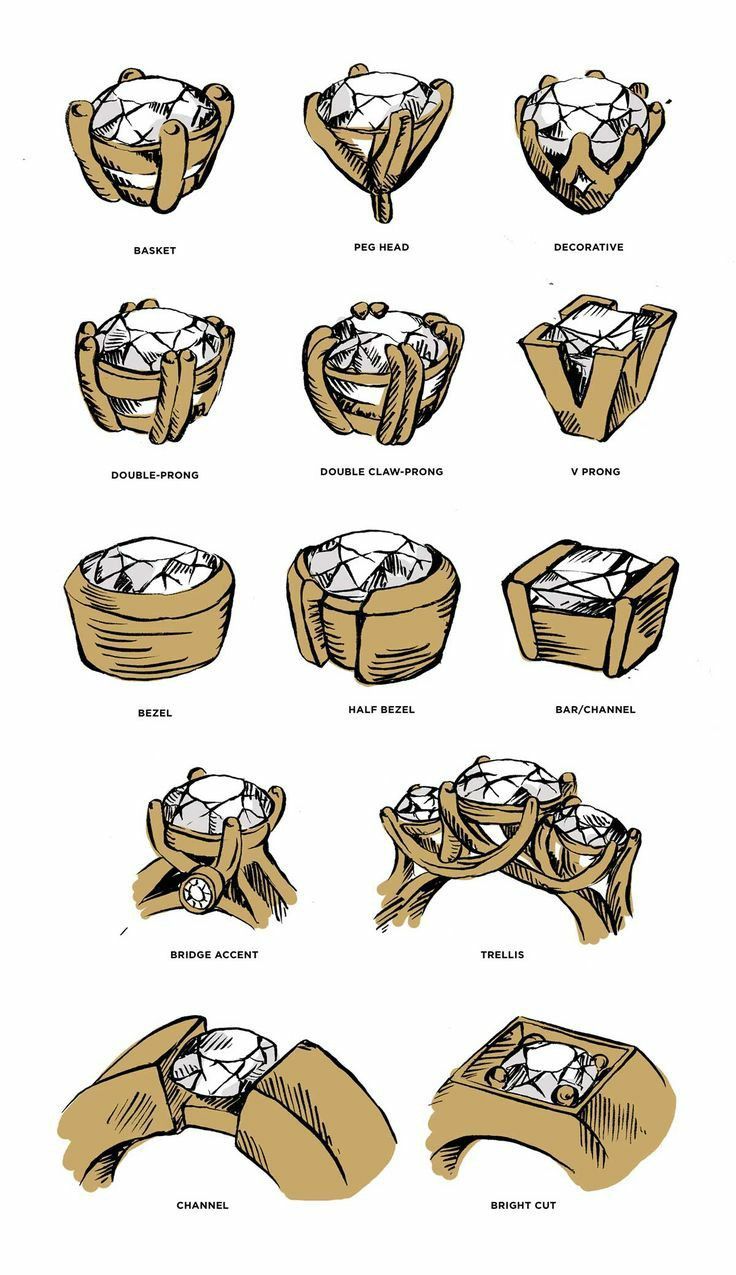
Common Jewelry Setting Types
Prong setting
Small metal prongs hold the stone while leaving much of its surface exposed. Prong position and consistency require careful inspection.
Bezel setting
A metal rim surrounds the stone's edge. It can provide a protective profile when designed and manufactured correctly.
Channel setting
Stones sit in a channel between parallel metal walls. Consistent spacing and alignment are important.
Pavé setting
Multiple small stones are set closely together to create a continuous decorative surface. It requires precise positioning and secure setting work.
Flush setting
The stone sits within the metal surface, creating a relatively low-profile appearance.
Tension-style setting
The stone is held through a carefully engineered structure that applies pressure at designated contact points. Its suitability depends on the material, geometry, and stone specifications.
How to Choose a Setting for Your Collection
The best setting balances design intent with the product's intended use.
For everyday jewelry, lower-profile settings or protective bezels may be appropriate for some designs. More exposed settings can create visual impact, but they may require additional attention to stone security and snagging risks.
During development, buyers should review:
Stone dimensions and tolerances.
Prong consistency and alignment.
Bezel wall thickness and uniformity.
Clearance beneath the stone.
Alignment of the setting with the jewelry body.
Access for polishing, cleaning, and inspection.
For custom designs with multiple stones, it is particularly important to assess whether the intended geometry can be manufactured consistently at the required production volume.
7. Jewelry Materials and Plating: What Buyers Need to Know in 2026
The visible color of jewelry does not reveal its underlying material. A gold-colored ring could be manufactured from brass, stainless steel, sterling silver, or another base material.
The correct choice depends on the design, budget, intended wear, and product positioning.
Jewelry Material Comparison
| Material | Common Advantages | Important Considerations |
|---|---|---|
| 316L stainless steel | Good corrosion resistance and strength | Manufacturing methods and design geometry affect feasibility |
| 304 stainless steel | Useful for selected fashion jewelry applications | Corrosion requirements should be assessed for the intended use |
| Brass | Suitable for many cast and detailed fashion designs | Plating, barrier layers, and wear testing require attention |
| 925 sterling silver | Precious-metal positioning and repairability | Tarnish, surface scratches, and maintenance need consideration |
| Gold and other precious metals | Suitable for precious-metal collections | Cost, alloy composition, and applicable marking requirements |
Material performance depends on more than the material name. Alloy grade, component design, manufacturing quality, surface treatment, and actual wear conditions all matter.
316L Stainless Steel
316L stainless steel is commonly selected for fashion jewelry that requires strength and corrosion resistance.
It can be suitable for chains, rings, pendants, bracelets, and selected earring components. However, not every design or manufacturing process is equally suitable for stainless steel.
For skin-contact products, buyers should specify the material grade and verify applicable nickel-release or other compliance requirements through appropriate testing. A material description alone should not be treated as proof of compliance.
Brass Jewelry
Brass jewelry is widely used in fashion jewelry because it supports a broad range of shapes, decorative details, and finishing options.
Its performance depends heavily on the alloy, polishing, surface preparation, plating system, and protective layers.
For gold-tone brass jewelry, ask the manufacturer to identify the plating process, coating specifications, and any relevant test results. High-friction areas, including ring shanks and clasp edges, should receive particular attention.
925 Sterling Silver
925 sterling silver contains 92.5% silver by mass, with the balance generally made up of other metals used to achieve the desired properties.
It is suitable for brands developing precious-metal collections, but silver can tarnish and may show scratches during wear. Surface finishing, storage, and care instructions should reflect the intended product.
PVD Coating vs. Electroplating
PVD coating stands for Physical Vapor Deposition. It is a coating technology used to apply thin functional or decorative films under controlled processing conditions.
Electroplating deposits a metal coating through an electrochemical process.
These processes are not interchangeable, and neither automatically guarantees a particular service life.
| Comparison | PVD Coating | Electroplating |
|---|---|---|
| Process | Vapor-based deposition | Electrochemical deposition |
| Typical considerations | Substrate preparation, coating composition, adhesion | Underlayers, deposit thickness, adhesion |
| Color options | Depends on coating system | Depends on plating chemistry and process |
| Durability | Depends on coating and test conditions | Depends on plating system and test conditions |
| Verification | Appropriate coating and wear tests | Thickness, adhesion, and wear tests |
When comparing suppliers, request the actual process specification instead of relying only on terms such as “premium gold” or “long-lasting color.”
For projects where coating thickness affects the specification, suitable measurement methods, including X-ray fluorescence (XRF) where applicable, can help verify the coating system. The measurement method and its limitations should be considered when interpreting the result.
A Practical Material and Finish Checklist
Before approving a production sample:
Confirm the base metal and grade.
Specify the finish color and reference sample.
Identify the coating or plating process.
Clarify the coating thickness where relevant.
Review high-friction areas separately.
Confirm the applicable skin-contact and chemical compliance requirements.
Request relevant test reports when performance claims depend on them.
For B2B buyers, these records help establish a clear and repeatable production standard.
8. How to Source Jewelry Components from a Manufacturer
Choosing jewelry components is not just a purchasing task. It is part of product development, cost management, and quality control.
A reliable custom jewelry manufacturer should be able to explain how the design moves from concept to sampling and then into repeatable manufacturing.
Step 1: Prepare a Detailed Technical Pack
Include drawings or CAD files, dimensions, material requirements, finish references, stone specifications, logos, and packaging requirements.
For complex assemblies, identify individual components separately.
Step 2: Confirm Material and Component Specifications
Ask the manufacturer to confirm the material used for each critical component, especially earring posts, clasps, jump rings, hinges, and other parts that carry loads or contact the skin.
Step 3: Review the Sample
Evaluate more than appearance. Check dimensions, weight, comfort, assembly, surface quality, closure function, and stone security where applicable.
Step 4: Approve the Finish
Confirm the base material, color target, plating or coating method, and any agreed testing requirements before approving the final sample.
Step 5: Establish Quality Control Criteria
Define acceptable dimensions, cosmetic standards, functional tests, and inspection requirements. Where needed, agree on sampling methods and acceptance criteria before bulk production.
Step 6: Confirm Production and Packaging
Review the MOQ, production lead time, packaging specifications, branding details, and shipping arrangements.
Step 7: Protect Your Design Information
For proprietary designs, use appropriate confidentiality agreements and establish clear arrangements for CAD files, custom molds, tooling, and authorized production use.
A well-defined process makes it easier to compare manufacturers fairly and reduces the risk of misunderstandings during production.
9. Jewelry Quality Control: Where to Look First
A product can look excellent in a photograph and still have problems that only become apparent during handling or wear.
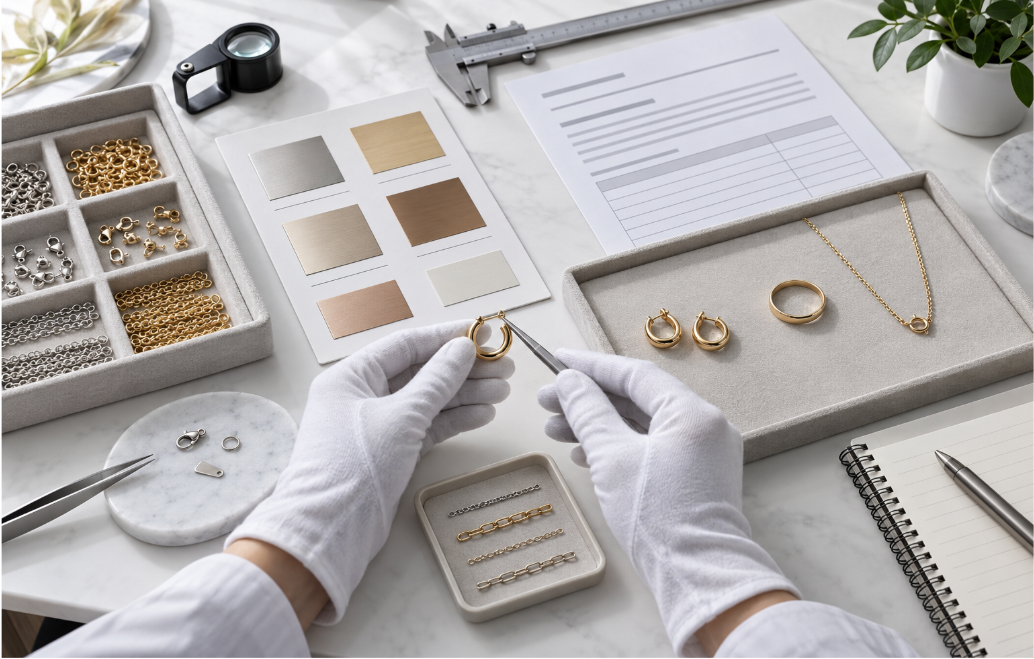
Jewelry quality control should cover both visible surfaces and functional components.
Structural Quality
Check for:
Weak joints or poorly assembled connections.
Misaligned components.
Deformed links or ring shanks.
Loose hinges and closures.
Inadequate attachment points.
Surface Quality
Check for:
Scratches, dents, and visible polishing marks.
Uneven color or plating coverage.
Rough edges and unfinished areas.
Inconsistent logo placement.
Residue or defects around recessed details.
Functional Quality
Check for:
Clasps that open or close incorrectly.
Earring backs with unsuitable tension.
Hinges that bind or move excessively.
Stones that move within their settings.
Chains or connectors that fail under appropriate test conditions.
Material and Compliance Checks
Depending on the product and destination market, relevant checks may include material verification, coating thickness, adhesion, corrosion resistance, nickel release, and applicable chemical compliance testing.
Salt spray testing, for example, can provide useful information about corrosion behavior under defined test conditions. However, a salt spray result should not automatically be translated into a specific number of years of real-world wear.
Similarly, a single test cannot prove every aspect of product quality. Testing should be selected according to the actual product, materials, finish, and market requirements.
For brands working with an OEM/ODM jewelry manufacturer, agreed inspection criteria and documented approvals are more useful than a general promise of “strict quality control.”
10. Jewelry Component Quick Reference Table
Use this table when preparing a technical pack, requesting quotations, or comparing samples from different suppliers.
| Jewelry Type | Critical Components | Main Sourcing Priority |
|---|---|---|
| Earrings | Posts, backs, hooks, hinges | Comfort, retention, alignment |
| Rings | Shank, shoulders, head, setting | Dimensions, deformation resistance, finish wear |
| Bracelets | Links, end caps, hinges, clasps | Connection strength and closure function |
| Necklaces | Chain, bail, jump rings, clasp | Pendant compatibility and attachment security |
| Pendants | Body, bail, connectors, setting | Geometry, finish, connection strength |
| Charms | Decorative body, loops, attachment rings | Correct sizing and secure attachment |
| Gemstone jewelry | Setting, prongs, bezel, stone mount | Stone security and manufacturing precision |
The table can also serve as a starting point for a supplier comparison checklist. More complex designs may require additional part-level specifications and inspection criteria.
11. Jewelry Glossary: Essential Terms for Buyers
Bail: A component that connects a pendant or charm to a chain.
Bezel setting: A setting in which metal surrounds the edge of a stone.
Clasp: A mechanism used to open and close a necklace, bracelet, or other jewelry item.
Connector: A component that joins two or more jewelry elements.
Earring post: The stem that passes through a pierced ear.
Finding: A functional jewelry component, such as a clasp, jump ring, or ear wire.
Gallery: The structure beneath or around a jewelry setting that supports the stone and influences the appearance of the piece.
Jump ring: A small metal ring used to connect jewelry components.
Pavé setting: A setting style in which multiple small stones are placed closely together.
PVD: Physical Vapor Deposition, a process used to deposit thin coatings onto a surface.
Shank: The main band of a ring.
Tech pack: A technical document that records the dimensions, materials, finishes, construction details, and other production requirements of a product.
OEM: Original Equipment Manufacturing, in which a manufacturer produces products according to a customer's requirements.
ODM: Original Design Manufacturing, in which a manufacturer provides design and development capabilities as part of the production service.
Knowing these terms helps buyers communicate more accurately with product developers, engineers, and production teams.
12. How MCGA Jewelry Supports Custom Jewelry Manufacturing
At MCGA Jewelry, we understand that successful jewelry production begins with clear product specifications and continues through coordinated manufacturing and quality control.
Our Vietnam-based manufacturing operation supports B2B customers developing custom jewelry collections for brands, retailers, designers, and wholesale businesses.
Depending on the project, our manufacturing capabilities include:
Material options: 316L stainless steel, brass, and 925 sterling silver.
OEM/ODM development: Support for customized designs, product specifications, and sampling.
Manufacturing processes: Casting, CNC machining, welding, polishing, plating, PVD coating, and gemstone setting, depending on product requirements.
Surface finishing: Options selected according to the material, design, and target finish.
Brand customization: Logo marking, product details, and packaging requirements.
Production coordination: Sampling approval, manufacturing planning, quality checks, and packaging.
Not every process or finish is suitable for every design. Our team evaluates the requested material, structure, appearance, and production requirements to determine the appropriate manufacturing route.
For new brands, clear specifications can also make it easier to evaluate MOQ, sample development, target pricing, and production feasibility before committing to a larger order.
Whether you are developing a stainless steel pendant, a brass fashion jewelry collection, or a 925 sterling silver design, choosing the right components is an important step toward achieving consistent quality.
Final Thoughts
The quality of a jewelry piece depends on how its individual jewelry components work together. The right chain, clasp, setting, base metal, and surface finish can help a design achieve its intended appearance and performance.
For jewelry brands and B2B buyers, understanding the parts of jewelry makes supplier communication more precise and product development more efficient.
At MCGA Jewelry, we work with businesses to evaluate custom jewelry requirements, select suitable materials and manufacturing processes, and develop products for their target markets.
Planning a new jewelry collection?
📩Contact MCGA Jewelry, your Vietnam-based jewelry manufacturer, to discuss your design, material requirements, and OEM/ODM jewelry manufacturing project.
MCGA Jewelry — Your Vietnam-Based Partner for Custom Jewelry Manufacturing.